

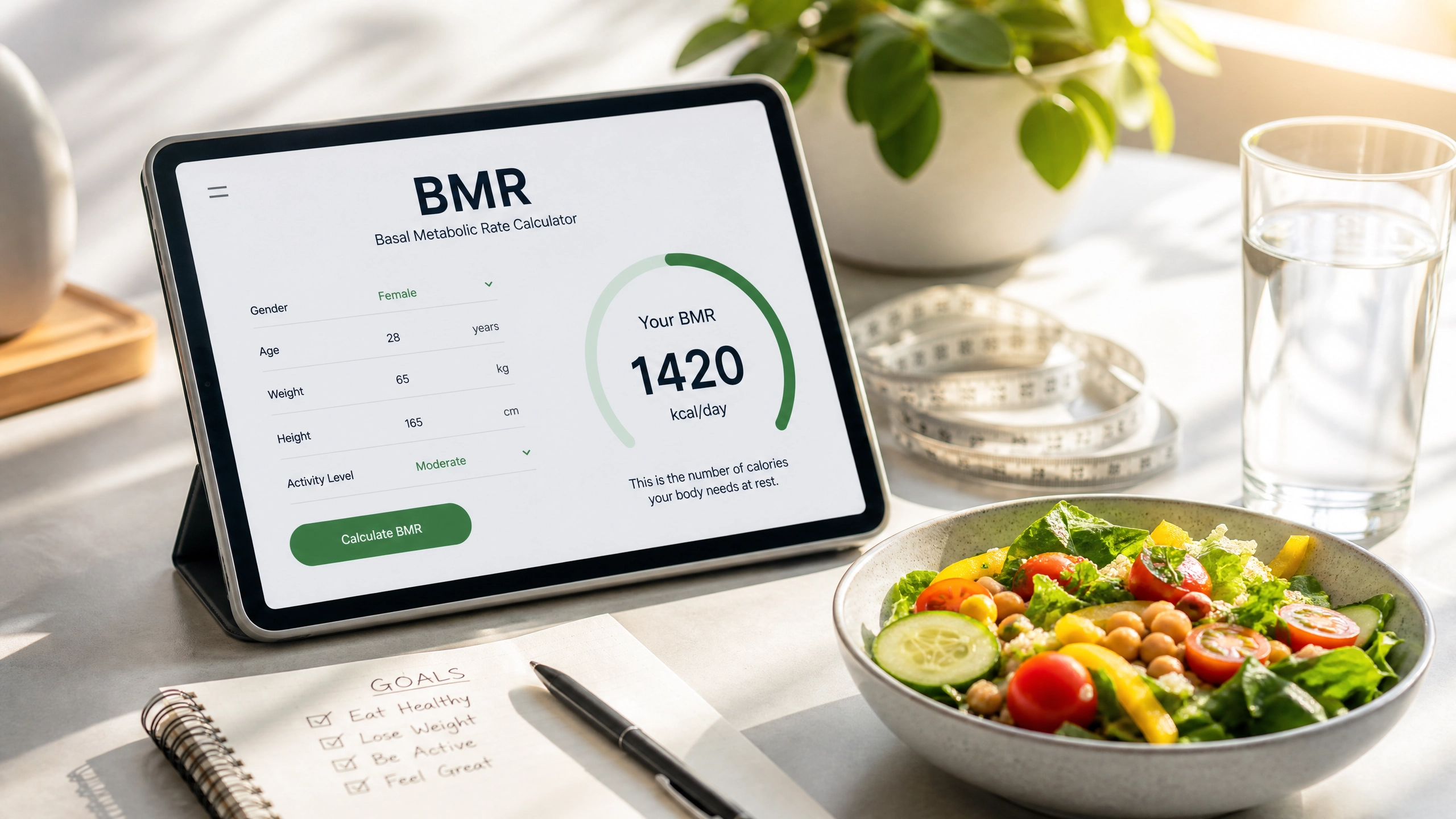
Are you struggling to lose weight despite your best efforts? The secret might lie in understanding your body’s unique energy needs. Your Basal Metabolic Rate (BMR) is a powerful metric that can unlock effective and sustainable weight loss. In this comprehensive guide, we’ll dive deep into what BMR is, how to calculate it, and most importantly, how to leverage this knowledge to achieve your weight loss goals. Say goodbye to generic diet plans and hello to a personalized approach!
What is Basal Metabolic Rate (BMR)?
Your Basal Metabolic Rate (BMR) is the number of calories your body burns at rest to maintain basic life-sustaining functions. Think of it as the energy your body needs just to exist – breathing, circulation, cell production, and maintaining body temperature. It accounts for a significant portion (around 60-75%) of your total daily energy expenditure.
Understanding your BMR is crucial because it provides a baseline. Any physical activity you do throughout the day, from walking to intense exercise, burns additional calories on top of your BMR.
How to Calculate Your BMR
While laboratory tests can provide the most accurate BMR measurement, several widely accepted formulas can give you a very close estimate. The most common equations are the Mifflin-St Jeor Equation and the Revised Harris-Benedict Equation.
Use our free BMR Calculator to find your personalized Basal Metabolic Rate instantly!
Click here to use the NutritionExtract BMR Calculator!
(Simply enter your gender, age, weight, and height, and our tool will provide your estimated BMR and TDEE.)
The Mifflin-St Jeor Equation (Most commonly used and considered more accurate for modern populations):
•For Men: BMR = (10 × weight in kg) + (6.25 × height in cm) – (5 × age in years) + 5
•For Women: BMR = (10 × weight in kg) + (6.25 × height in cm) – (5 × age in years) – 161
The Revised Harris-Benedict Equation:
•For Men: BMR = (13.397 × weight in kg) + (4.799 × height in cm) – (5.677 × age in years) + 88.362
•For Women: BMR = (9.247 × weight in kg) + (3.098 × height in cm) – (4.330 × age in years) + 447.593
Understanding Your Total Daily Energy Expenditure (TDEE)
Your BMR is just one piece of the puzzle. To truly understand your daily calorie needs, you need to calculate your Total Daily Energy Expenditure (TDEE). Your TDEE is your BMR multiplied by an activity factor, which accounts for your daily physical activity level.
Activity Levels:
•Sedentary: Little to no exercise (BMR x 1.2)
•Lightly Active: Light exercise/sports 1-3 days/week (BMR x 1.375)
•Moderately Active: Moderate exercise/sports 3-5 days/week (BMR x 1.55)
•Very Active: Hard exercise/sports 6-7 days/week (BMR x 1.725)
•Extra Active: Very hard exercise/physical job/training twice a day (BMR x 1.9)
Our BMR Calculator also provides your TDEE, making it easy to get a complete picture of your daily calorie burn.
Creating a Calorie Deficit for Effective Weight Loss
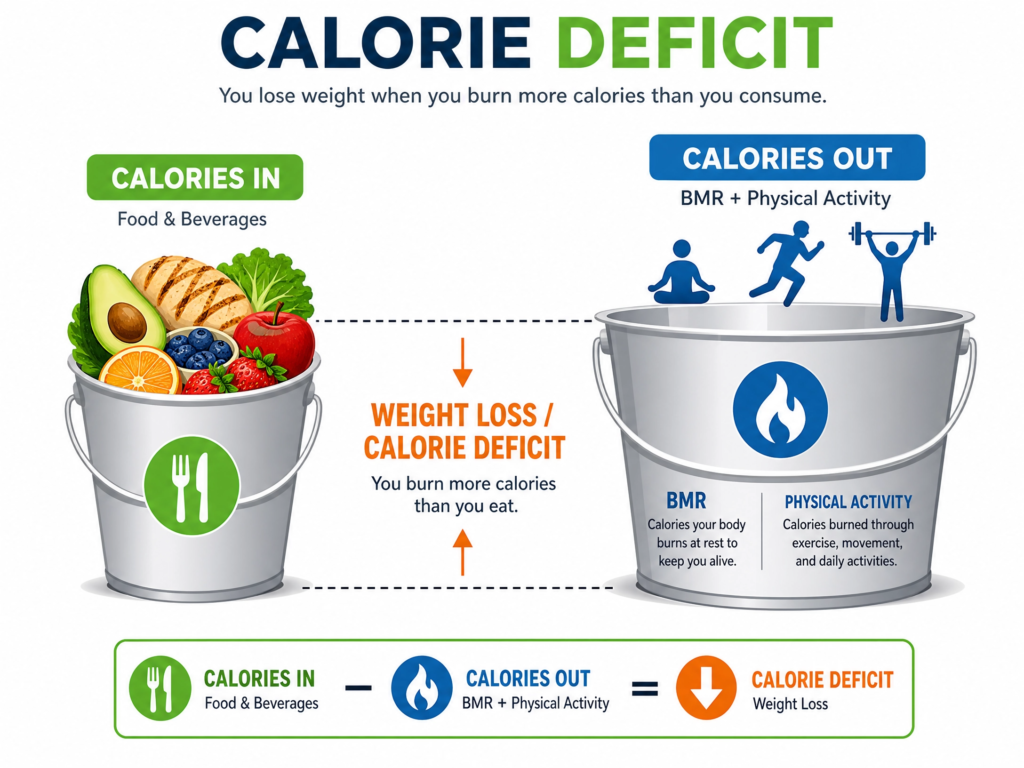
Weight loss fundamentally comes down to creating a calorie deficit: consuming fewer calories than your body burns. Once you know your TDEE, you can strategically reduce your calorie intake to promote fat loss.
Steps to Create a Calorie Deficit:
1.Calculate Your BMR and TDEE: Use our NutritionExtract BMR Calculator to get these numbers.
2.Determine Your Deficit: A safe and sustainable weight loss typically involves a deficit of 500-750 calories per day. This usually results in a weight loss of 1-1.5 pounds (0.5-0.7 kg) per week.
•Example: If your TDEE is 2500 calories, aiming for 1800-2000 calories per day would create a healthy deficit.
3.Track Your Intake: Use a food tracking app or journal to monitor your daily calorie consumption. Be honest and consistent for accurate results.
4.Monitor Progress & Adjust: Your body adapts. If weight loss stalls, you may need to slightly adjust your calorie intake or increase your activity level. Re-evaluate your BMR and TDEE every few months.
Beyond the Numbers: Factors Affecting Your BMR
While formulas provide a good estimate, several factors can influence your actual BMR:
•Age: BMR generally decreases with age as muscle mass tends to decline.
•Gender: Men typically have a higher BMR than women due to a higher percentage of muscle mass.
•Body Composition: Muscle tissue burns more calories at rest than fat tissue. The more lean muscle mass you have, the higher your BMR.
•Height and Weight: Taller and heavier individuals generally have higher BMRs because they have more body mass to maintain.
•Genetics: Your genes play a role in determining your metabolic rate.
•Thyroid Hormones: An overactive thyroid (hyperthyroidism) can increase BMR, while an underactive thyroid (hypothyroidism) can decrease it.
Common Mistakes to Avoid When Using BMR for Weight Loss
•Eating Too Little: Drastically cutting calories below your BMR can be counterproductive. It can slow down your metabolism, lead to nutrient deficiencies, and make it harder to sustain weight loss long-term. (See also: “Is Eating Below Your BMR Safe? The Truth About Starvation Mode and Fat Loss.”)
•Ignoring Activity Level: Only focusing on BMR without considering your TDEE will lead to inaccurate calorie targets.
•Not Re-evaluating: As you lose weight, your BMR and TDEE will change. Regularly recalculate to ensure your calorie targets remain appropriate.
•Expecting Instant Results: Sustainable weight loss is a marathon, not a sprint. Be patient and consistent.
Integrating BMR into Your Weight Loss Journey
1.Personalized Calorie Targets: Use your BMR and TDEE as the foundation for setting realistic daily calorie goals.
2.Strategic Exercise: Incorporate strength training to build muscle mass, which naturally boosts your BMR.
3.Balanced Nutrition: Focus on whole, unprocessed foods that provide essential nutrients and keep you feeling full.
4.Adequate Sleep: Lack of sleep can negatively impact metabolism and hormone regulation, making weight loss harder.
5.Stress Management: Chronic stress can also affect your metabolism and lead to weight gain.
Understanding and utilizing your Basal Metabolic Rate is a game-changer for effective weight loss. It moves you away from guesswork and towards a science-backed, personalized approach. By knowing how many calories your body burns at rest and factoring in your activity level, you can create a sustainable calorie deficit that leads to real, lasting results.
Ready to take control of your weight loss journey? Start by finding your BMR today!
Call to Action
Calculate your BMR and TDEE now with our easy-to-use tool: NutritionExtract BMR Calculator
Explore more articles on personalized nutrition and weight management:
•Does Ignitra Really Work? A Deep Dive into Ignitra Supplement
•Is Longevity Activator Worth It? My Honest Review (2026)
•Is Sugar Defender Worth It? An In-Depth Review of This Blood Sugar Supplement
Was this review helpful to you?
Leave your like to help us!